

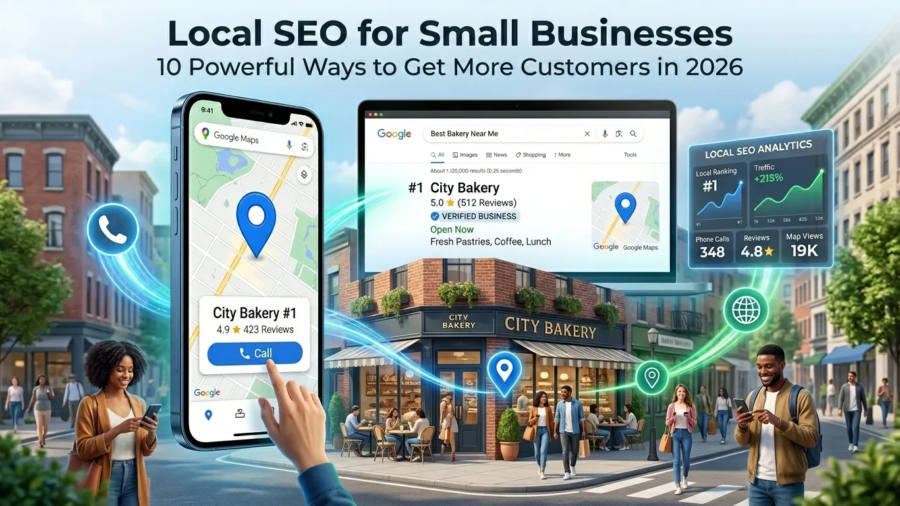
Local SEO for Small Businesses: 10 Powerful Ways to Get More Customers in 2026

Local SEO for Small Businesses: 10 Powerful Ways to Get More Customers in 2026

Introduction

Local SEO for small businesses has become one of the most effective ways to attract customers in 2026. Whether you run a service business, retail store, consulting company, or professional practice, people are searching online for businesses near them every day.

When someone searches for terms like:

  • website designer near me
  • SEO consultant near me
  • coffee shop near me
  • plumber near me

Google prioritizes businesses with strong local SEO signals.

The challenge is that many small businesses either ignore local SEO or implement it incorrectly. As a result, competitors appear higher in search results and capture more customers.

This guide explains 10 powerful local SEO strategies that can help your business improve visibility, attract more local customers, and generate more leads.

local SEO for small businesses

Why Local SEO Matters in 2026

Consumer behavior continues to shift toward local search.

Before contacting a business, many customers now:

  • Search Google
  • Read reviews
  • Check Google Maps
  • Visit websites
  • Compare competitors

If your business is not visible in local search results, potential customers may never discover your services.

Strong local SEO helps:

  • Increase visibility
  • Build trust
  • Generate qualified leads
  • Improve website traffic
  • Attract nearby customers

Optimize Your Google Business Profile

Your Google Business Profile is one of the most important local SEO assets.

An optimized profile can help your business appear in:

  • Google Search
  • Google Maps
  • Local Pack results

Make sure your profile includes:

  • Accurate business name
  • Phone number
  • Website
  • Business category
  • Services
  • Business description

Businesses with complete profiles often perform better in local searches

You can create and manage your business listing through Google Business Profile to improve your visibility in Google Search and Google Maps.

Google Business Profile optimization

Use Consistent Business Information Everywhere

Google wants consistent information across the internet.

Your:

  • Business name
  • Address
  • Phone number

should match everywhere your business is listed.

Inconsistent information can confuse both users and search engines.

Check:

  • Business directories
  • Social media profiles
  • Review websites
  • Local listings

Consistency strengthens local SEO signals.

Target Local Keywords

One of the most effective local SEO strategies is targeting location-based keywords.

Examples:

  • website designer in Yaoundé
  • SEO consultant in Cameroon
  • local SEO services in Nigeria
  • WordPress developer in Douala

These keywords help Google understand where your business operates.

Include local keywords naturally in:

  • Page titles
  • Headings
  • Service pages
  • Meta descriptions
  • Blog content

Create Location-Specific Service Pages

Many businesses make the mistake of creating one generic services page.

Instead, consider creating dedicated pages for important locations.

Examples:

  • SEO Services in Yaoundé
  • Website Design Services in Douala
  • SEO Consultant in Cameroon

Location pages help improve visibility for geographically relevant searches.

Create Location-Specific Service Pages

Many businesses make the mistake of creating one generic services page.

Instead, consider creating dedicated pages for important locations.

Examples:

  • SEO Services in Yaoundé
  • Website Design Services in Douala
  • SEO Consultant in Cameroon

Location pages help improve visibility for geographically relevant searches.

Collect More Customer Reviews

Reviews are a major ranking factor for local SEO.

Positive reviews help:

  • Build trust
  • Improve visibility
  • Increase conversions

Encourage satisfied clients to leave reviews on your Google Business Profile.

The more genuine reviews your business receives, the stronger your local presence can become.

customer reviews for local SEO

Optimize Your Website for Mobile Users

Most local searches now happen on mobile devices.

A mobile-friendly website should:

  • Load quickly
  • Display correctly on all devices
  • Have readable text
  • Offer easy navigation

Poor mobile experiences often lead to higher bounce rates and lost opportunities.

You can test your website’s performance using Google PageSpeed Insights to identify speed and usability issues that may affect rankings and conversions.

For additional optimization tips, read:

On-Page SEO Checklist for 2026: 10 Powerful Steps to Improve Rankings


Create Helpful Local Content

Content remains an important part of local SEO.

Examples include:

  • Local industry guides
  • Community updates
  • Local business tips
  • Regional case studies

Useful local content can help attract both visitors and backlinks.

It also signals relevance to search engines.

Google’s recommendations for creating helpful, people-first content can be found in Google Search Central Documentation.

Build Local Citations

Local citations are mentions of your business online.

Examples include:

  • Business directories
  • Industry directories
  • Chamber of commerce websites
  • Local associations

Quality citations strengthen local trust and authority.

Focus on reputable directories rather than quantity.

Improve Website User Experience

Even the best local SEO strategy can fail if visitors dislike your website.

Focus on:

  • Clear navigation
  • Fast load times
  • Strong calls-to-action
  • Professional design
  • Easy contact options

Many businesses lose customers because visitors leave before taking action.

Research from Nielsen Norman Group consistently shows that user experience has a significant impact on engagement and website performance.

For more insights, read:

7 Critical Reasons Visitors Leave Your Website Without Taking Action in 2026

Build Local Authority and Trust

Google wants to recommend trustworthy businesses.

Authority can be strengthened through:

  • Customer reviews
  • Backlinks
  • Partnerships
  • Industry recognition
  • Quality content

Trust is increasingly important for both search rankings and conversions.

Businesses with strong authority signals often outperform competitors.

Backlinks remain an important ranking factor, and resources from Moz Beginner’s Guide to SEO can help businesses understand how authority influences search visibility.


Local SEO for Small Businesses: Key Takeaways

Local SEO for small businesses is one of the most valuable marketing investments you can make in 2026.

The businesses that succeed locally are often those that:

  • Optimize their Google Business Profile
  • Collect reviews
  • Target local keywords
  • Build citations
  • Create useful content
  • Improve user experience

Implementing these strategies can help your business attract more local customers and improve visibility in Google Search and Google Maps.

Conclusion

Local SEO continues to be one of the most effective ways for small businesses to grow online.

Unlike broad marketing campaigns, local SEO targets people who are actively searching for products or services in a specific area.

By applying the strategies discussed in this guide, your business can improve visibility, generate more leads, and compete more effectively in local search results.

Small improvements made consistently often produce significant long-term results.

Need Help Improving Your Local SEO?

If you want to improve your local rankings, optimize your website, or attract more customers through search engines, professional guidance can make a significant difference.

At Ngulefac Digital, I help businesses improve SEO performance, strengthen their online presence, and create websites designed to generate leads.

Contact me today for a free consultation and discover how local SEO can help your business grow.

Frequently Asked Questions

What is local SEO?

Local SEO is the process of optimizing your online presence so your business appears in local search results and Google Maps.

Why is local SEO important for small businesses?

Local SEO helps businesses attract nearby customers who are actively searching for products or services.

Does Google Business Profile help SEO?

Yes. An optimized Google Business Profile can significantly improve local visibility and help businesses appear in Google Maps and local search results.

How long does local SEO take?

Many businesses begin seeing improvements within a few months, although results depend on competition, optimization quality, and consistency.

Why Visitors Leave Your Website Without Taking Action. 7 Critical Reasons in 2026

Why Visitors Leave Your Website Without Taking Action. 7 Critical Reasons in 2026

Introduction

Why visitors leave your website without taking action is one of the biggest challenges businesses face in 2026. Many business owners invest time and money into building a website, creating content, and driving traffic, only to discover that visitors are leaving without contacting them, requesting a quote, or making a purchase.

The truth is that getting traffic is only part of the equation. If your website fails to engage visitors, build trust, and guide them toward a clear action, you will continue losing potential customers. Understanding why visitors leave your website without taking action can help you identify weaknesses in your website and improve your conversion rates.

In this guide, we’ll explore seven critical reasons visitors abandon websites and what you can do to keep them engaged.

why visitors leave your website without taking action

Why Website Conversions Matter More Than Ever in 2026

Businesses today face more competition online than ever before. Users have countless options available, and their expectations continue to rise.

Modern visitors expect:

  • Fast-loading pages
  • Clear messaging
  • Professional design
  • Mobile-friendly experiences
  • Easy navigation
  • Instant trust signals

If your website fails to meet these expectations, visitors often leave within seconds.

Many businesses focus heavily on traffic but ignore conversion optimization. As a result, they attract visitors but struggle to generate leads or sales.

1. Your Value Proposition Is Not Clear

One of the most common reasons visitors leave a website is confusion.

When someone lands on your homepage, they should immediately understand:

  • What you do
  • Who you help
  • Why they should choose you

Many websites use vague headlines and generic marketing language that fail to communicate their value.

Examples of weak headlines:

  • “Welcome to Our Website”
  • “We Build Digital Experiences”
  • “Innovative Solutions for Modern Businesses”

These statements sound impressive but tell visitors very little.

A strong headline clearly communicates your offer and target audience.

For example:

“Professional WordPress Websites That Help Small Businesses Get More Clients.”

This instantly explains what you do and who you help.

clear website headline example

2. Your Website Loads Too Slowly

Website speed has a direct impact on user experience and conversions.

Studies consistently show that visitors are more likely to abandon slow websites.

Common causes of slow websites include:

  • Large image files
  • Poor hosting
  • Too many plugins
  • Unoptimized code
  • Excessive animations

A slow website can negatively affect:

  • User engagement
  • Search engine rankings
  • Conversion rates

To improve performance:

  • Compress images
  • Use quality hosting
  • Enable caching
  • Remove unnecessary plugins
  • Optimize scripts and files

You can test your website speed using Google PageSpeed Insights.

3.Your Navigation Is Confusing

Visitors should never have to guess where to click next.

Poor navigation creates frustration and causes users to leave.

Common navigation mistakes include:

  • Too many menu items
  • Unclear labels
  • Cluttered layouts
  • Hidden important pages

Your navigation should help visitors quickly find:

  • Services
  • Pricing
  • Portfolio
  • Contact information
  • About page

The easier it is to navigate your website, the longer visitors are likely to stay.

Your Website Looks Outdated

First impressions matter.

Visitors often judge a business based on the appearance of its website.

An outdated website can make a business appear:

  • Unprofessional
  • Untrustworthy
  • Inactive
  • Behind competitors

Signs of an outdated website include:

  • Old design styles
  • Poor typography
  • Low-quality images
  • Inconsistent branding
  • Non-responsive layouts

Modern websites should focus on:

  • Clean layouts
  • Professional visuals
  • Strong branding
  • Mobile responsiveness
  • User-friendly design
outdated business website design example

5. Your Calls-To-Action Are Weak or Missing

Visitors need clear direction.

A call-to-action (CTA) tells users what to do next.

Without strong CTAs, visitors may leave even if they are interested in your services.

Weak CTA examples:

  • Learn More
  • Click Here
  • Read More

Stronger CTA examples:

  • Request a Free Consultation
  • Get a Website Audit
  • Book a Discovery Call
  • Start Your Project Today

Effective CTAs should be:

  • Visible
  • Clear
  • Action-oriented
  • Relevant to visitor intent

Every important page should contain at least one strong CTA.

6. Your Content Does Not Match Visitor Intent

Another reason why visitors leave your website without taking action is that the content fails to address their needs.

Visitors arrive with specific questions and expectations.

If your content does not provide relevant answers, they will quickly leave.

Examples include:

  • Attracting the wrong audience
  • Targeting irrelevant keywords
  • Providing shallow information
  • Ignoring customer pain points

Before creating content, understand your audience’s goals and challenges.

For more guidance, read:

How to Identify Your Target Audience in 2026: 9 Powerful Strategies for Business Growth

When content aligns with visitor intent, engagement and conversions typically improve.

7. There Are No Trust Signals

Trust is a major factor in conversion decisions.

Visitors want evidence that your business is credible and capable of delivering results.

Trust signals include:

  • Client testimonials
  • Case studies
  • Portfolio examples
  • Reviews
  • Certifications
  • Professional branding

Without trust signals, visitors may hesitate to contact you.

Adding social proof can significantly improve conversion rates.

website trust signals and testimonials

Why Visitors Leave Your Website Without Taking Action: Key Takeaways

Understanding why visitors leave your website without taking action is essential if you want to generate more leads and customers online.

The most common reasons include:

  • Unclear messaging
  • Slow loading speeds
  • Confusing navigation
  • Outdated design
  • Weak calls-to-action
  • Poor content alignment
  • Lack of trust signals

Addressing these issues can improve user experience and help convert more visitors into paying customers.

How to Improve Website Conversions in 2026

Use this quick checklist:

  • Clarify your value proposition
  • Improve page speed
  • Simplify navigation
  • Modernize website design
  • Strengthen CTAs
  • Create audience-focused content
  • Add testimonials and case studies
  • Optimize for mobile users
  • Improve SEO strategy

For more website optimization tips, read:

How to Build a Website That Gets Clients (and Avoid Common Mistakes 2026)

7 Critical Reasons Why Your Website Is Not Getting Traffic (And How to Fix It Fast in 2026)

Conclusion

Many businesses focus heavily on attracting traffic but overlook what happens after visitors arrive.

The reality is that website success depends on both traffic and conversions.

By understanding why visitors leave your website without taking action and fixing the issues discussed in this guide, you can improve engagement, increase trust, and generate more leads from your website.

Small improvements often lead to significant long-term results.

Frequently Asked Questions

Why do visitors leave websites quickly?

Visitors often leave due to slow loading speeds, poor design, confusing navigation, unclear messaging, or lack of trust.

Does website design affect conversions?

Yes. Website design strongly influences trust, user experience, and whether visitors take action.

How can I reduce my website bounce rate?

Improve website speed, create better content, simplify navigation, and add stronger calls-to-action.

Why is my website getting traffic but no leads?

This often happens when the website attracts the wrong audience or fails to guide visitors toward a conversion action.

Ready to Turn More Website Visitors Into Customers?

If your website is getting traffic but not generating leads, the problem may not be your marketing—it may be your website experience.

I help businesses create high-performing websites that are designed to build trust, improve conversions, and attract more clients.

Whether you need:

  • A new website
  • A website redesign
  • SEO improvements
  • Conversion optimization

I’m here to help.

Contact me today for a free website review and discover what’s preventing visitors from taking action.

AI SEO strategy

AI SEO Strategy for 2026: 10 Powerful Ways to Rank in Google and AI Search

Introduction

An effective AI SEO strategy is becoming essential for businesses, creators, and marketers in 2026.

Search behavior is changing rapidly.

People are no longer relying only on traditional search engines. Many users now search using AI-powered platforms like:

This means modern SEO is evolving beyond traditional keyword optimization.

Businesses now need content that performs well across:

  • Google Search
  • AI Overviews
  • conversational AI
  • answer engines

In this guide, you’ll learn practical strategies for building a strong AI SEO strategy in 2026.

What Is AI SEO Strategy?

AI SEO strategy refers to optimizing content for both:

  • traditional search engines
  • AI-powered search systems

This includes improving:

  • content structure
  • authority
  • readability
  • conversational relevance
  • topical depth

Modern AI systems increasingly summarize and recommend content directly to users.

This is changing how websites attract visibility online.

Why AI Is Changing SEO in 2026

SEO is experiencing one of its biggest transformations in years.

Google continues expanding AI-powered search experiences including:

  • AI Overviews
  • AI Mode
  • conversational search interfaces

Research and industry reports show:

  • AI-generated answers are appearing more frequently
  • zero-click searches are increasing
  • informational content competition is growing

This means businesses must adapt their content strategies.

AI SEO Strategy for 2026 (Complete Guide)

A strong AI SEO strategy focuses on:

  • helpful content
  • structured answers
  • authority signals
  • topical expertise
  • cross-platform visibility

Let’s go through the most important strategies.

1. Focus on Topical Authority
Modern SEO increasingly rewards websites with deep topical expertise.

Instead of publishing random articles, build:

  • topic clusters
  • interconnected blog posts
  • comprehensive guides

For example:
An SEO-focused website should cover:

  • keyword research
  • on-page SEO
  • technical SEO
  • AI SEO
  • blogging strategies

Topic clusters consistently outperform isolated articles.

People now search using questions like:

  • “How do I improve my SEO?”
  • “What is the best AI SEO strategy?”
  • “How can businesses rank in AI search?”

Your content should answer these questions naturally.

This improves:

  • AI visibility
  • featured snippets
  • conversational search relevance

3. Structure Content Clearly

Structured content performs better for:

  • users
  • Google
  • AI systems

Best practices include:

  • H2 and H3 headings
  • bullet points
  • short paragraphs
  • FAQs
  • definitions

AI systems prefer content that is easy to extract and summarize.

4. Improve E-E-A-T Signals

Google increasingly prioritizes:

  • Experience
  • Expertise
  • Authority
  • Trust

This is especially important in AI-driven search environments.

You should improve:

  • author bios
  • case studies
  • testimonials
  • portfolio examples
  • practical insights

Authority matters more than ever.

5. Use Internal Linking Aggressively

Internal linking helps:

  • distribute authority
  • improve crawlability
  • strengthen topic relevance

For example, this article should internally link to:
🔗 on-page SEO checklist

🔗 how to identify your target audience

Strong internal linking supports topical authority.

6. Create Helpful Human-Focused Content

Modern AI systems increasingly prioritize:

  • usefulness
  • clarity
  • expertise
  • originality

Low-quality AI-generated content is becoming less effective.

Your content should:

  • solve problems
  • provide insights
  • explain concepts clearly
  • share practical experience

7. Optimize for AI Overviews

AI Overviews are appearing more frequently in Google search results.

To improve visibility:

  • answer questions directly
  • use concise explanations
  • include FAQs
  • structure information clearly

Well-structured content has a better chance of being referenced.

8. Expand Beyond Google

Modern SEO is becoming:

Search Everywhere Optimization

Businesses should build visibility across:

  • LinkedIn
  • Pinterest
  • Quora
  • Reddit
  • YouTube

Cross-platform presence is becoming increasingly important for AI visibility.

9. Build Brand Signals

AI systems increasingly rely on:

  • authority mentions
  • citations
  • backlinks
  • brand recognition

This means businesses should focus on:

  • digital PR
  • social visibility
  • backlinks
  • community engagement

Strong brand signals improve trust.

SEO is evolving rapidly.

Businesses should monitor:

  • AI search behavior
  • ranking changes
  • keyword trends
  • AI visibility

Useful tools include:

Tracking trends helps businesses adapt faster.

What Is Generative Engine Optimization?

Generative Engine Optimization (GEO) refers to optimizing content for AI-generated search systems.

GEO focuses on:

  • structured answers
  • semantic relevance
  • conversational content
  • authority signals

Industry experts increasingly view GEO as an important evolution of SEO.

Common AI SEO Mistakes

Some common mistakes include:

  • publishing low-quality AI content
  • ignoring topical authority
  • weak internal linking
  • poor structure
  • focusing only on keywords

Modern SEO now requires a broader strategy.

How AI Search Changes Website Traffic

AI-generated search results are increasing zero-click searches.

This means websites should focus more on:

  • authority building
  • brand recognition
  • commercial intent keywords
  • trust signals

Businesses that adapt early may gain a major advantage.

Final Thoughts

Building a strong AI SEO strategy is becoming essential for online visibility in 2026.

Modern SEO now combines:

  • traditional SEO
  • AI optimization
  • authority building
  • topical expertise
  • conversational content

The websites that perform best will likely be those that provide:

  • useful information
  • structured answers
  • trusted expertise
  • strong brand presence

SEO is evolving rapidly, but businesses that adapt early can gain a powerful long-term advantage.

Need Help Improving Your SEO and AI Visibility?

If you want help:

  • optimizing your website
  • improving SEO
  • building AI-friendly content
  • increasing visibility online

I can help you create a stronger digital presence.

Contact me and let’s grow your online visibility.

FAQ

What is AI SEO strategy?

AI SEO strategy involves optimizing content for both traditional search engines and AI-powered search systems.


How is AI changing SEO?

AI is changing SEO by increasing conversational search, AI-generated answers, and zero-click searches.


What is Generative Engine Optimization?

Generative Engine Optimization (GEO) focuses on optimizing content for AI-generated search experiences.


Can AI-generated content rank on Google?

Yes, but content quality, usefulness, originality, and authority remain very important.


How to Identify Your Target Audience in 2026 9 Powerful Strategies for Business Growth

How to Identify Your Target Audience in 2026: 9 Powerful Strategies for Business Growth

Introduction
Understanding how to identify your target audience is one of the most important parts of building a successful business in 2026.

Many businesses struggle with marketing because they try to target everyone instead of focusing on the right audience.

If you learn how to identify your target audience, you can:

  • create better content
  • improve marketing
  • attract better clients
  • increase conversions

In this guide, you’ll learn practical strategies for finding and understanding your ideal customers.

how to identify your target audience marketing research illustration

What Is a Target Audience?

A target audience is the specific group of people most likely to:

  • buy your product
  • use your service
  • engage with your content

Your target audience is usually defined by:

  • interests
  • goals
  • problems
  • demographics
  • online behavior

For example:
A web designer may target:

  • small businesses
  • startups
  • entrepreneurs
  • professionals needing websites

Understanding your audience helps improve your marketing strategy significantly.

Why Identifying Your Target Audience Matters


Businesses that understand their audience usually perform better online.

Knowing your target audience helps you:

  • create better content
  • improve SEO
  • write better ads
  • attract quality clients
  • improve conversions

If your website is not attracting the right visitors, learning why your website is not getting traffic can help identify major SEO and content problems.

Without audience research, marketing becomes less effective.

How to Identify Your Target Audience (Complete Guide)

Learning how to identify your target audience becomes easier when you follow a structured process.

Let’s go through the most important strategies.

1. Understand the Problems You Solve


Start by identifying what problems your business solves.

Ask yourself:

  • What challenges do my clients face?
  • What services do they need?
  • Why would someone hire me?

For example:
If you build websites, your audience may struggle with:

  • poor website design
  • low traffic
  • weak online presence

Understanding problems helps define your ideal audience.

2. Analyze Your Existing Audience

If you already have:

  • website visitors
  • social media followers
  • past clients

Study them carefully.

Look for patterns such as:

  • age groups
  • industries
  • locations
  • interests

You can use:

This helps you understand who already engages with your content.

audience analytics dashboard illustration

3. Research Your Competitors

Competitor research is extremely valuable.

Study:

  • who competitors target
  • what content performs well
  • what audience engages most

You can learn a lot by analyzing:

  • blog comments
  • social media engagement
  • reviews
  • popular topics

Competitor research helps identify opportunities in your market.

4. Create Customer Personas

A customer persona is a detailed profile of your ideal client.

A good persona may include:

  • age
  • profession
  • goals
  • challenges
  • interests
  • online behavior

Example:

“Small business owner who needs a professional website to attract clients online.”

Customer personas improve marketing clarity.

5. Identify Where Your Audience Spends Time Online

Different audiences use different platforms.

For example:

  • professionals often use LinkedIn
  • younger audiences may use Instagram or TikTok
  • business owners often search on Google

Understanding platform behavior improves content distribution.

6. Use SEO and Search Data

SEO research can reveal what your audience searches for online.

Useful tools include:

Keyword research helps identify:

  • audience interests
  • problems
  • search intent

This is extremely useful for content creation.

People now ask conversational questions like:

  • “How do I grow my business online?”
  • “What website should I use?”
  • “How can AI help my business?”

Platforms like:

are influencing search behavior.

8. Test Different Content Types

Different audiences respond to different content styles.

Test:

  • blog posts
  • videos
  • carousels
  • tutorials
  • guides

Track:

  • engagement
  • clicks
  • shares
  • comments

This helps identify what your audience prefers.

9. Continuously Refine Your Audience

Your audience can evolve over time.

As your business grows, continue analyzing:

  • content performance
  • customer behavior
  • SEO trends
  • audience interests

Audience research should be an ongoing process.

Common Target Audience Mistakes

Some common mistakes include:

  • targeting everyone
  • ignoring audience data
  • poor market research
  • inconsistent messaging
  • focusing only on demographics

The more specific your audience, the stronger your marketing usually becomes.

How AI Is Changing Audience Research

AI systems are changing how businesses understand customers.

Today, businesses use AI tools to:

  • analyze trends
  • discover audience behavior
  • generate content ideas
  • identify search patterns

Modern marketing increasingly combines:

  • SEO
  • analytics
  • AI research
  • behavioral insights

Businesses that adapt early may gain a strong competitive advantage.

Final Thoughts

If you are building a business website, understanding how to build a website that gets clients and avoid common mistakes can help improve your online presence significantly. Read More on how to build a website that gets clients and avoid common mistakes

The better you understand your audience:

  • the better your content performs
  • the easier marketing becomes
  • the stronger your conversions grow

Successful businesses rarely market to everyone.

They focus on reaching the right people with the right message.

Need Help Growing Your Online Presence?

If you want help:

  • identifying your audience
  • improving SEO
  • building a better website
  • creating content strategies

I can help you build a stronger online presence and attract better clients.

Contact me and let’s grow your business online.

FAQ

What is a target audience?

A target audience is the group of people most likely to buy your product or use your service.


Why is identifying your target audience important?

It helps improve marketing, content creation, SEO, and customer targeting.


How do businesses identify their target audience?

Businesses analyze:

  • customer behavior
  • SEO data
  • demographics
  • interests
  • competitor audiences

Can AI help identify target audiences?

Yes. AI tools can help analyze trends, search behavior, and customer interests more efficiently.


On-Page SEO Checklist for 2026 10 Powerful Steps to Improve Rankings

On-Page SEO Checklist for 2026: 10 Powerful Steps to Improve Rankings

Introduction

On-page SEO checklist strategies are essential if you want your website to rank higher on Google in 2026.

Many websites struggle to get traffic because their pages are not properly optimized for search engines or AI-driven search systems.

If you follow a strong on-page SEO checklist, you can improve rankings, increase visibility, and create content that performs better across both Google and AI search platforms.

on-page SEO checklist optimization dashboard illustration

What Is On-Page SEO?

On-page SEO is the process of optimizing individual website pages to improve search engine rankings and user experience.

Why On-Page SEO Matters in 2026

SEO is evolving rapidly. Today, websites are optimized not only for Google but also for AI-powered search systems like ChatGPT and Google Gemini.

On-Page SEO Checklist for 2026 (Complete Guide)

1. Use Your Focus Keyword Properly

Your focus keyword should appear naturally throughout your content, including titles, meta descriptions, and subheadings.

2. Optimize Your SEO Title

Your SEO title is one of the strongest ranking signals. Include your keyword and a number to improve click-through rates.

3. Write a Strong Meta Description

Meta descriptions help users understand your content before clicking. Keep them clear and direct.

4. Use Proper Headings Structure

Good structure improves readability for both users and AI systems. Use one H1, followed by H2s and H3s.

5. Optimize Images for SEO

Compress image sizes and add descriptive ALT text to improve speed and accessibility.

6. Improve Internal Linking

Internal linking helps connect your content together and improves website structure.

External links to trusted sources like Moz improve credibility.

8. Improve Website Speed

A slow website reduces performance. Use quality hosting and compress images to stay fast.

9. Optimize for Mobile Devices

Most users browse on mobile. Ensure your site adapts to all screen sizes.

10. Create Helpful, Human-Focused Content

Prioritize helpful content that answers real questions and solves real problems.

How AI Is Changing On-Page SEO

AI search systems are changing discovery. Use conversational language and structured answers to stay relevant.

Common On-Page SEO Mistakes

Avoid keyword stuffing, slow speeds, and poor mobile experiences to maintain high rankings.

Final Thoughts

A strong on-page SEO checklist is your foundation for long-term growth in 2026.

Need Help Optimizing Your Website for SEO?

Contact me for professional SEO strategy and content optimization.

FAQ

What is on-page SEO?

On-page SEO refers to optimizing website pages to improve rankings and user experience.

why your website is not getting traffic

7 Critical Reasons Why Your Website Is Not Getting Traffic (And How to Fix It Fast in 2026)

Introduction

You’ve built your website, but no one is visiting it.

At this point, you’re probably wondering why your website is not getting traffic and what you’re doing wrong.

This is a common issue. Many websites fail not because they look bad, but because they lack the right strategy.

If your website is not getting traffic, it usually means something important is missing.

In this guide, you’ll learn:

  • Why your website is not getting traffic
  • The most common mistakes
  • How to fix them step by step
website traffic is low analytics chart

Why Your Website Is Not Getting Traffic (And How to Fix It)

There is no single reason behind low traffic. In most cases, it is a combination of issues that limit your visibility and growth.

Once you understand these problems, fixing them becomes much easier.

1. No SEO Strategy

One of the main reasons why your website is not getting traffic is the absence of SEO.

Without SEO, your website does not appear on search engines. That means people searching for your services will never find you.

Many beginners:

  • Do not use keywords
  • Do not optimize their pages
  • Do not publish content

As a result, their website remains invisible.

If you want a deeper understanding, you can explore how SEO works through SEO for beginners step-by-step guide

2. Targeting the Wrong Keywords

Another reason why your website is not getting traffic is poor keyword selection.

Even if you are using keywords, they may not match what people are actually searching for.

Common mistakes include:

  • Targeting highly competitive keywords
  • Ignoring search intent
  • Using vague or irrelevant terms

A better approach is to focus on:

  • Long-tail keywords
  • Specific problems
  • Clear search intent

The right keywords attract the right audience.

keyword research SEO example

3. Poor Content Quality

Content is a major factor in SEO.

If your content is weak or not useful, it will not rank and will not keep visitors engaged.

Common issues:

  • Very short articles
  • No real value
  • Poor structure

Good content should:

  • Answer specific questions
  • Be easy to read
  • Provide practical solutions

If your content is not helpful, it will not bring traffic.

4. No Consistency

Publishing one or two blog posts is not enough.

If your website is not getting traffic, lack of consistency could be the reason.

Search engines prefer websites that:

  • Publish regularly
  • Stay active
  • Update content

Without consistency, it is difficult to build authority.

Even one quality post per week can make a difference.

5. Weak Website Structure

A poor structure makes it harder for both users and search engines to navigate your site.

This often leads to low engagement and poor rankings.

Common problems:

  • No internal linking
  • Confusing layout
  • Missing important pages

A strong structure helps:

  • Improve user experience
  • Increase time on site
  • Support SEO performance

To build a website with a good structure, read this article build a website that gets clients

6. Slow Website Speed

Speed is a key ranking factor.

If your website is slow, users will leave before it fully loads.

This increases bounce rate and reduces your chances of ranking.

Common causes:

  • Large images
  • Too many plugins
  • Poor hosting

You can test your performance using Google PageSpeed Insights.

website speed performance test

7. No Promotion Strategy

Publishing content alone is not enough.

If your website is not getting traffic, it may be because you are not promoting it.

You need to actively push your content.

Simple ways to promote:

  • Share on social media
  • Engage in communities
  • Build backlinks

Promotion helps your content reach a wider audience.

How to Fix Low Website Traffic (Simple Action Plan)

If your website is not getting traffic, start with these steps:

  • Do proper keyword research
  • Optimize your pages
  • Create valuable content
  • Stay consistent
  • Improve website speed
  • Promote your content

Focus on one step at a time and build gradually.

Final Thoughts

Understanding why your website is not getting traffic is the first step toward fixing it.

Traffic comes from strategy, not luck.

When you combine SEO, content, and consistency, your website can start attracting the right audience.

Need Help Growing Your Website Traffic?

If your website is not getting traffic and you want real results:

I can help you with:

  • SEO strategy
  • Content optimization
  • Website performance improvements

Contact me and let’s grow your website.