

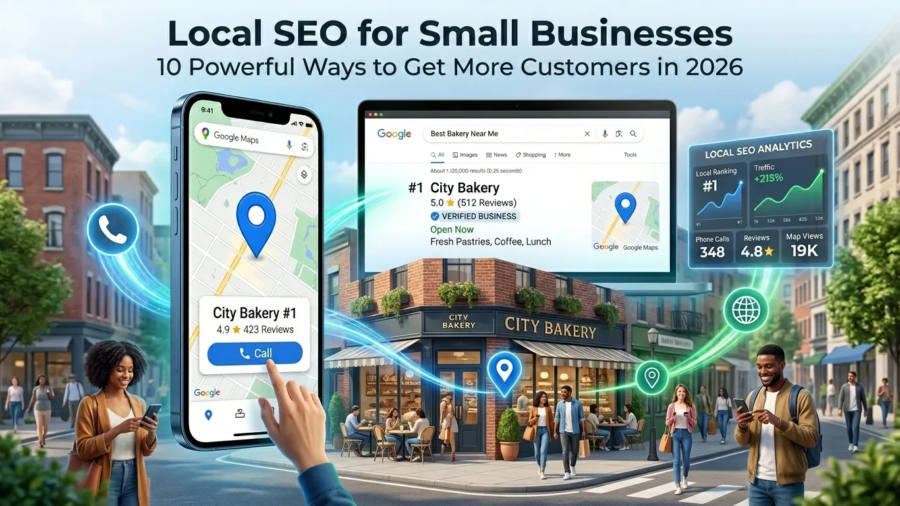
Local SEO for Small Businesses: 10 Powerful Ways to Get More Customers in 2026

Local SEO for Small Businesses: 10 Powerful Ways to Get More Customers in 2026

Introduction

Local SEO for small businesses has become one of the most effective ways to attract customers in 2026. Whether you run a service business, retail store, consulting company, or professional practice, people are searching online for businesses near them every day.

When someone searches for terms like:

  • website designer near me
  • SEO consultant near me
  • coffee shop near me
  • plumber near me

Google prioritizes businesses with strong local SEO signals.

The challenge is that many small businesses either ignore local SEO or implement it incorrectly. As a result, competitors appear higher in search results and capture more customers.

This guide explains 10 powerful local SEO strategies that can help your business improve visibility, attract more local customers, and generate more leads.

local SEO for small businesses

Why Local SEO Matters in 2026

Consumer behavior continues to shift toward local search.

Before contacting a business, many customers now:

  • Search Google
  • Read reviews
  • Check Google Maps
  • Visit websites
  • Compare competitors

If your business is not visible in local search results, potential customers may never discover your services.

Strong local SEO helps:

  • Increase visibility
  • Build trust
  • Generate qualified leads
  • Improve website traffic
  • Attract nearby customers

Optimize Your Google Business Profile

Your Google Business Profile is one of the most important local SEO assets.

An optimized profile can help your business appear in:

  • Google Search
  • Google Maps
  • Local Pack results

Make sure your profile includes:

  • Accurate business name
  • Phone number
  • Website
  • Business category
  • Services
  • Business description

Businesses with complete profiles often perform better in local searches

You can create and manage your business listing through Google Business Profile to improve your visibility in Google Search and Google Maps.

Google Business Profile optimization

Use Consistent Business Information Everywhere

Google wants consistent information across the internet.

Your:

  • Business name
  • Address
  • Phone number

should match everywhere your business is listed.

Inconsistent information can confuse both users and search engines.

Check:

  • Business directories
  • Social media profiles
  • Review websites
  • Local listings

Consistency strengthens local SEO signals.

Target Local Keywords

One of the most effective local SEO strategies is targeting location-based keywords.

Examples:

  • website designer in Yaoundé
  • SEO consultant in Cameroon
  • local SEO services in Nigeria
  • WordPress developer in Douala

These keywords help Google understand where your business operates.

Include local keywords naturally in:

  • Page titles
  • Headings
  • Service pages
  • Meta descriptions
  • Blog content

Create Location-Specific Service Pages

Many businesses make the mistake of creating one generic services page.

Instead, consider creating dedicated pages for important locations.

Examples:

  • SEO Services in Yaoundé
  • Website Design Services in Douala
  • SEO Consultant in Cameroon

Location pages help improve visibility for geographically relevant searches.

Create Location-Specific Service Pages

Many businesses make the mistake of creating one generic services page.

Instead, consider creating dedicated pages for important locations.

Examples:

  • SEO Services in Yaoundé
  • Website Design Services in Douala
  • SEO Consultant in Cameroon

Location pages help improve visibility for geographically relevant searches.

Collect More Customer Reviews

Reviews are a major ranking factor for local SEO.

Positive reviews help:

  • Build trust
  • Improve visibility
  • Increase conversions

Encourage satisfied clients to leave reviews on your Google Business Profile.

The more genuine reviews your business receives, the stronger your local presence can become.

customer reviews for local SEO

Optimize Your Website for Mobile Users

Most local searches now happen on mobile devices.

A mobile-friendly website should:

  • Load quickly
  • Display correctly on all devices
  • Have readable text
  • Offer easy navigation

Poor mobile experiences often lead to higher bounce rates and lost opportunities.

You can test your website’s performance using Google PageSpeed Insights to identify speed and usability issues that may affect rankings and conversions.

For additional optimization tips, read:

On-Page SEO Checklist for 2026: 10 Powerful Steps to Improve Rankings


Create Helpful Local Content

Content remains an important part of local SEO.

Examples include:

  • Local industry guides
  • Community updates
  • Local business tips
  • Regional case studies

Useful local content can help attract both visitors and backlinks.

It also signals relevance to search engines.

Google’s recommendations for creating helpful, people-first content can be found in Google Search Central Documentation.

Build Local Citations

Local citations are mentions of your business online.

Examples include:

  • Business directories
  • Industry directories
  • Chamber of commerce websites
  • Local associations

Quality citations strengthen local trust and authority.

Focus on reputable directories rather than quantity.

Improve Website User Experience

Even the best local SEO strategy can fail if visitors dislike your website.

Focus on:

  • Clear navigation
  • Fast load times
  • Strong calls-to-action
  • Professional design
  • Easy contact options

Many businesses lose customers because visitors leave before taking action.

Research from Nielsen Norman Group consistently shows that user experience has a significant impact on engagement and website performance.

For more insights, read:

7 Critical Reasons Visitors Leave Your Website Without Taking Action in 2026

Build Local Authority and Trust

Google wants to recommend trustworthy businesses.

Authority can be strengthened through:

  • Customer reviews
  • Backlinks
  • Partnerships
  • Industry recognition
  • Quality content

Trust is increasingly important for both search rankings and conversions.

Businesses with strong authority signals often outperform competitors.

Backlinks remain an important ranking factor, and resources from Moz Beginner’s Guide to SEO can help businesses understand how authority influences search visibility.


Local SEO for Small Businesses: Key Takeaways

Local SEO for small businesses is one of the most valuable marketing investments you can make in 2026.

The businesses that succeed locally are often those that:

  • Optimize their Google Business Profile
  • Collect reviews
  • Target local keywords
  • Build citations
  • Create useful content
  • Improve user experience

Implementing these strategies can help your business attract more local customers and improve visibility in Google Search and Google Maps.

Conclusion

Local SEO continues to be one of the most effective ways for small businesses to grow online.

Unlike broad marketing campaigns, local SEO targets people who are actively searching for products or services in a specific area.

By applying the strategies discussed in this guide, your business can improve visibility, generate more leads, and compete more effectively in local search results.

Small improvements made consistently often produce significant long-term results.

Need Help Improving Your Local SEO?

If you want to improve your local rankings, optimize your website, or attract more customers through search engines, professional guidance can make a significant difference.

At Ngulefac Digital, I help businesses improve SEO performance, strengthen their online presence, and create websites designed to generate leads.

Contact me today for a free consultation and discover how local SEO can help your business grow.

Frequently Asked Questions

What is local SEO?

Local SEO is the process of optimizing your online presence so your business appears in local search results and Google Maps.

Why is local SEO important for small businesses?

Local SEO helps businesses attract nearby customers who are actively searching for products or services.

Does Google Business Profile help SEO?

Yes. An optimized Google Business Profile can significantly improve local visibility and help businesses appear in Google Maps and local search results.

How long does local SEO take?

Many businesses begin seeing improvements within a few months, although results depend on competition, optimization quality, and consistency.

why your website is not getting traffic

7 Critical Reasons Why Your Website Is Not Getting Traffic (And How to Fix It Fast in 2026)

Introduction

You’ve built your website, but no one is visiting it.

At this point, you’re probably wondering why your website is not getting traffic and what you’re doing wrong.

This is a common issue. Many websites fail not because they look bad, but because they lack the right strategy.

If your website is not getting traffic, it usually means something important is missing.

In this guide, you’ll learn:

  • Why your website is not getting traffic
  • The most common mistakes
  • How to fix them step by step
website traffic is low analytics chart

Why Your Website Is Not Getting Traffic (And How to Fix It)

There is no single reason behind low traffic. In most cases, it is a combination of issues that limit your visibility and growth.

Once you understand these problems, fixing them becomes much easier.

1. No SEO Strategy

One of the main reasons why your website is not getting traffic is the absence of SEO.

Without SEO, your website does not appear on search engines. That means people searching for your services will never find you.

Many beginners:

  • Do not use keywords
  • Do not optimize their pages
  • Do not publish content

As a result, their website remains invisible.

If you want a deeper understanding, you can explore how SEO works through SEO for beginners step-by-step guide

2. Targeting the Wrong Keywords

Another reason why your website is not getting traffic is poor keyword selection.

Even if you are using keywords, they may not match what people are actually searching for.

Common mistakes include:

  • Targeting highly competitive keywords
  • Ignoring search intent
  • Using vague or irrelevant terms

A better approach is to focus on:

  • Long-tail keywords
  • Specific problems
  • Clear search intent

The right keywords attract the right audience.

keyword research SEO example

3. Poor Content Quality

Content is a major factor in SEO.

If your content is weak or not useful, it will not rank and will not keep visitors engaged.

Common issues:

  • Very short articles
  • No real value
  • Poor structure

Good content should:

  • Answer specific questions
  • Be easy to read
  • Provide practical solutions

If your content is not helpful, it will not bring traffic.

4. No Consistency

Publishing one or two blog posts is not enough.

If your website is not getting traffic, lack of consistency could be the reason.

Search engines prefer websites that:

  • Publish regularly
  • Stay active
  • Update content

Without consistency, it is difficult to build authority.

Even one quality post per week can make a difference.

5. Weak Website Structure

A poor structure makes it harder for both users and search engines to navigate your site.

This often leads to low engagement and poor rankings.

Common problems:

  • No internal linking
  • Confusing layout
  • Missing important pages

A strong structure helps:

  • Improve user experience
  • Increase time on site
  • Support SEO performance

To build a website with a good structure, read this article build a website that gets clients

6. Slow Website Speed

Speed is a key ranking factor.

If your website is slow, users will leave before it fully loads.

This increases bounce rate and reduces your chances of ranking.

Common causes:

  • Large images
  • Too many plugins
  • Poor hosting

You can test your performance using Google PageSpeed Insights.

website speed performance test

7. No Promotion Strategy

Publishing content alone is not enough.

If your website is not getting traffic, it may be because you are not promoting it.

You need to actively push your content.

Simple ways to promote:

  • Share on social media
  • Engage in communities
  • Build backlinks

Promotion helps your content reach a wider audience.

How to Fix Low Website Traffic (Simple Action Plan)

If your website is not getting traffic, start with these steps:

  • Do proper keyword research
  • Optimize your pages
  • Create valuable content
  • Stay consistent
  • Improve website speed
  • Promote your content

Focus on one step at a time and build gradually.

Final Thoughts

Understanding why your website is not getting traffic is the first step toward fixing it.

Traffic comes from strategy, not luck.

When you combine SEO, content, and consistency, your website can start attracting the right audience.

Need Help Growing Your Website Traffic?

If your website is not getting traffic and you want real results:

I can help you with:

  • SEO strategy
  • Content optimization
  • Website performance improvements

Contact me and let’s grow your website.

SEO for beginners

SEO for Beginners: Why Most Websites Fail to Rank (2026 Guide)

Introduction

If you have a website but you’re not getting traffic, the problem is most likely SEO. Many beginners struggle because SEO seems technical and complicated. But in reality, the basics are simple when broken down correctly. This guide will show you exactly how to approach SEO for beginners step by step, even if you have no prior experience.

By the end, you’ll understand how to:

  • Get your website visible on Google
  • Attract the right audience
  • Turn traffic into potential clients
SEO ranking website on Google

What is SEO and Why It Matters

SEO (Search Engine Optimization) is the process of improving your website so it appears on search engines like Google. When someone searches for a service or solution, SEO helps your website show up in the results.

Without SEO:

  • Your website stays invisible
  • You get little to no traffic
  • You miss potential clients

With SEO:

  • You attract organic traffic
  • You reach people actively searching
  • You grow your business consistently

If you want your site to succeed, you need both SEO and a solid structure. Here’s how to build a website that gets clients

How Search Engines Work

Search engines like Google scan and index websites to decide which pages to show for each query.

They focus on three main things:

  • Relevance (does your content match the search?)
  • Quality (is your content helpful?)
  • Authority (do other sites trust you?)

Understanding this helps you create content that ranks.

Step 1 – Keyword Research

Keyword research is the foundation of SEO.

It helps you understand what people are searching for.

Instead of guessing, you target real search terms like:

  • “SEO for beginners”
  • “how to rank on Google”

Tools you can use:

  • Google search suggestions
  • Keyword tools
  • Competitor analysis

Focus on long-tail keywords. They are easier to rank for and bring targeted traffic.

keyword research SEO example

Step 2 – On-Page SEO

On-page SEO is about optimizing your content.

Key elements include:

  • Title (must include your keyword)
  • Meta description
  • Headings (H1, H2, H3)
  • Keyword placement
  • Internal linking

Make sure your keyword appears:

  • In the first paragraph
  • In at least one subheading
  • Naturally throughout the content

Read More why your website is not getting traffic

Step 3 – Content Creation

Content is what drives SEO.

You need to create useful, relevant, and clear content that answers user questions.

Focus on:

  • Solving real problems
  • Writing clearly and simply
  • Providing value

Long-form content (like this guide) tends to perform better because it covers topics in depth.

Step 4 – Technical SEO Basics

Technical SEO ensures your website works properly.

Important areas:

  • Fast loading speed
  • Mobile responsiveness
  • Secure website (HTTPS) You get these with good hosting services like Hostinger
  • Clean URL structure

If your site is slow or broken, it won’t rank well.

Backlinks are links from other websites to yours.

Backlinks are one of the strongest signals search engines use to determine how trustworthy and authoritative your website is. When other websites link to your content, it tells search engines that your site provides value and can be relied on. However, it’s not just about quantity the quality of those links matters even more. A few links from reputable sites can have a bigger impact than many from low-quality sources.

They act as a signal of trust.

The more quality backlinks you have, the more authority your site gains.

Ways to get backlinks:

Guest posting

For SEO for beginners, guest posting is one of the easiest ways to start building backlinks. It involves writing articles for other websites or blogs in your industry, and in return, you usually get a link back to your site. This helps you reach a new audience, build credibility, and earn high-quality backlinks from trusted platforms.

Sharing valuable content

A key principle of SEO for beginners is creating valuable content that others want to share. When you publish useful guides, case studies, or unique insights, other websites are more likely to link to your content naturally. The more helpful and relevant your content is, the stronger your chances of gaining organic backlinks.

Networking

Another important strategy in SEO for beginners is networking. This means building relationships with other creators, business owners, or professionals in your industry. By connecting and collaborating, you increase your chances of getting mentioned or linked to on their websites, which helps grow your site’s authority over time.

SEO for Beginners: Why Most Websites Fail to Rank (2026 Guide) Common SEO Mistakes

Avoid these mistakes:

  • Keyword stuffing
  • Ignoring mobile optimization
  • Publishing low-quality content
  • Not using internal links
  • Expecting instant results

SEO takes time, but consistency brings results.

Final Thoughts

SEO is not complicated when you break it down.

Focus on:

  • Keywords
  • Content
  • Optimization
  • Consistency

If you apply these steps, your website will start gaining visibility and traffic.

Need Help With SEO?

If you want help optimizing your website and getting traffic:

I can help you with:

  • SEO strategy
  • Keyword research
  • Website optimization

Contact me to get started.